Decision Cycle
The Decision Cycle represents the continuous governance loop within DD&SA — from resident input to assembly deliberation, recommendations, and direct approval. It visualises how participation and legitimacy reinforce each other through iteration.
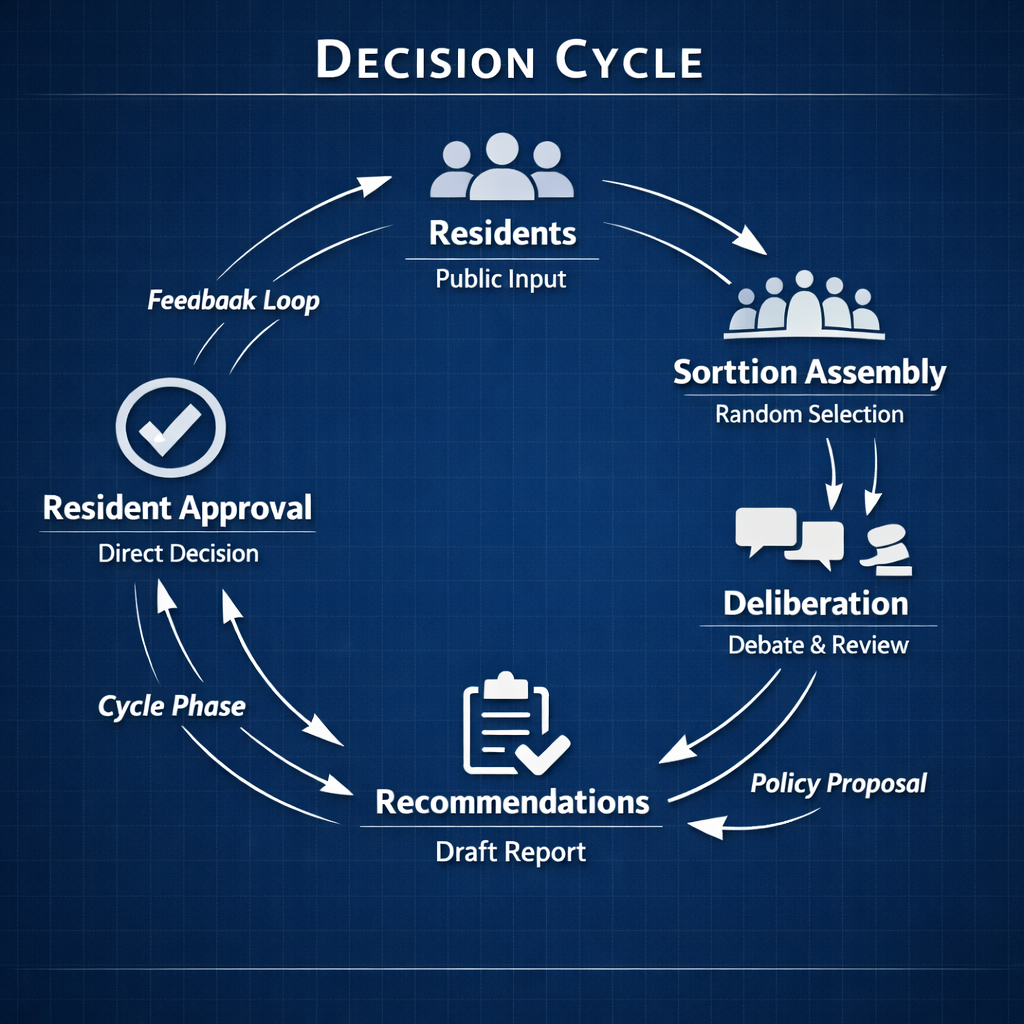
Each stage of the cycle is designed to maintain transparency and structural honesty: residents contribute input, assemblies deliberate, recommendations are published, and residents approve outcomes. The cycle then repeats, ensuring continuous accountability.
The five stages
- Resident input. Any resident may raise an issue or support one already raised. Nothing reaches an assembly because an official chose it.
- Agenda selection. Issues clearing the support threshold enter the queue in order, so the agenda is set by weight of resident interest rather than by party priority.
- Assembly deliberation. A sortition assembly hears evidence, questions expert witnesses under the adversarial briefing protocol, and deliberates in facilitated session.
- Published recommendation. The assembly publishes its recommendation together with its reasoning, its dissenting views, and the evidence it relied on. Nothing is decided in private.
- Direct approval. Residents vote on the recommendation. Approval makes it binding; rejection returns it to the queue with the objection on record.
The loop then restarts. Because every stage is published and every assembly is temporary, no actor accumulates the standing position from which capture normally operates. The full specification is set out in the Foundational Blueprint, and the reasoning behind binding direct approval is developed in Direct Democracy.
Related: the Sortition Process · How DD&SA works, step by step · The Sortition Architecture